Particle imaging velocimetry and infrared thermography
Background: Efficient heat removal is essential in many technical systems, from energy conversion and thermal process engineering to cooling of highly loaded components. Wall-impinging jets are especially attractive in this context because they can generate very high local heat-transfer rates. At the same time, real technical surfaces are rarely perfectly smooth. Their roughness can change the near-wall transport processes and therefore the effectiveness of cooling, yet detailed local measurements on rough surfaces are still difficult to obtain with conventional methods. From a fluid-mechanics perspective, impinging jets are also a demanding benchmark problem. The flow decelerates strongly as it approaches the wall, changes direction, and develops into a wall jet, creating steep gradients and complex near-wall dynamics. This combination of practical relevance and challenging physics makes the configuration an ideal test case for advancing both measurement techniques and numerical methods.
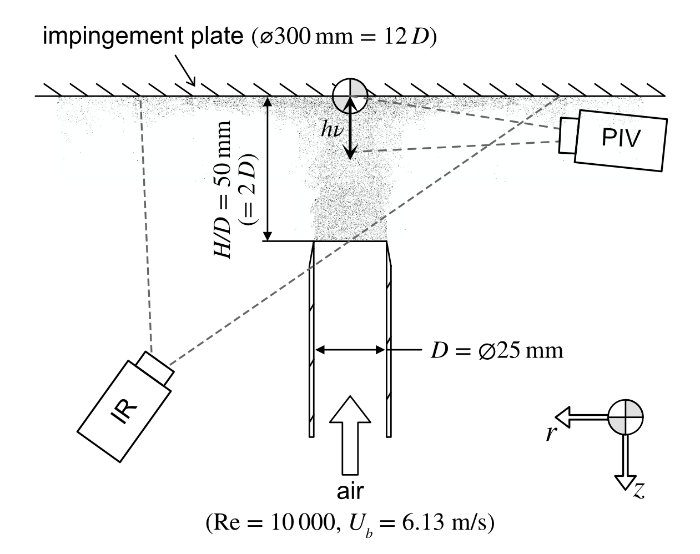
Project: Here we combine carefully controlled experiments with high-fidelity simulations to study a round jet impinging on a wall under well-defined conditions. Smooth and statistically rough surfaces are investigated over a broad range of operating conditions, so that flow behavior and heat transfer can be analyzed in a consistent framework rather than through global averages alone. For the thermal measurements, an infrared-based gradient sensor on thermally thick metallic plates is developed and employed. This makes it possible to integrate realistic roughness directly into the test surface and still obtain spatially resolved wall-temperature data. Through pixel-wise infrared calibration, geometric correction of the images, and a heat-balance model, these temperature fields are converted into detailed maps of local heat flux and heat-transfer intensity. To capture the flow field, the experiments are complemented by particle image velocimetry (PIV) and, in collaboration with our partners, by direct numerical simulation as well as an approach to modeling Reynolds stress with vortex resolution. Using the same canonical setup across all methods allows the different datasets to be compared directly and provides a robust basis for linking local flow structures, wall-shear conditions, and thermal transport.
Contact: Thomas Häber
Funding: CRC/TRR150 - Turbulent, chemically reactive, multi-phase flows near walls
Collaboration: - Prof. Dr.-Ing. Bettina Frohnapfel, Institute of Fluid Mechanics, Karlsruhe Institute of Technology - Prof. Dr.-Ing. habil. Suad Jakirlic, Institute for Fluid Mechanics and Aerodynamics, TU Darmstadt
Selected publications:
M. Bopp, T. Häber, F. Secchi, S. Schulz, S. Wegt, L. Krüger, R. Suntz, D. Trimis, B. Frohnapfel, S. Jakirlić, Mean flow and turbulence anisotropy representation in a round jet impingement: experiment, DNS and modeling, Eur. J. Mech. B. Fluids 120 (2026) 204592. https://doi.org/10.1016/j.euromechflu.2026.204592.
T. Häber, S. Moosmayer, F. Secchi, M. Raiola, D. Gatti, D. Trimis, R. Suntz, B. Frohnapfel, Spatially resolved heat transfer measurements of impinging jets on statistically rough surfaces using an infrared-based gradient sensor, Exp. Therm Fluid Sci. (2026) accepted. https://doi.org/10.1016/j.expthermflusci.2026.111797
F. Secchi, T. Häber, D. Gatti, S. Schulz, D. Trimis, R. Suntz, B. Frohnapfel, Turbulent impinging jets on rough surfaces, GAMM-Mitt. 45 (2022) 71–89. https://doi.org/10.1002/gamm.202200005.