Cleaning NOx emissions from hydrogen engines
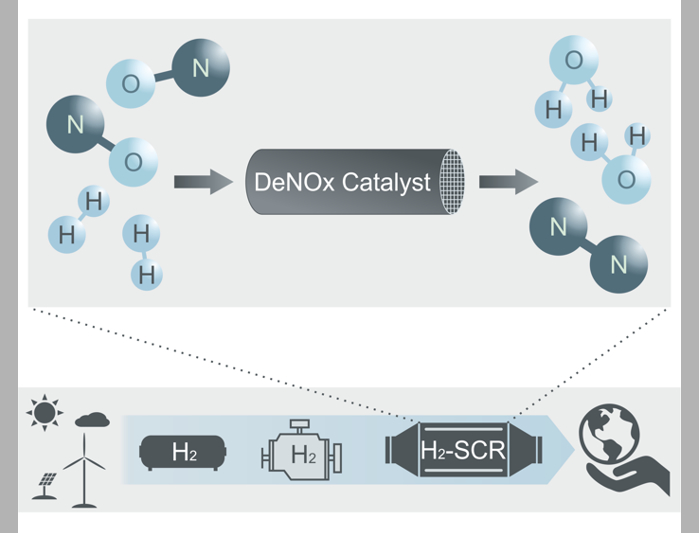
Background: On the way towards sustainability, climate-friendly hydrogen-fueled internal combustion engines allow to decarbonize applications that cannot rely on electrification due to limited capacity of state-of-the-art batteries, for instance, heavy-duty off-road applications as commonly used on construction sites. Despite their comparably clean exhausts, combustion results in the formation of nitrogen oxides (NOx), which need to be converted into elemental nitrogen (N₂) and water (H₂O). The so-called H₂-SCR, which is the selective catalytic reduction (SCR) of these nitrogen oxides with hydrogen that is already available as a fuel onboard, is the most elegant solution in principle. Currently, the overwhelming majority of H₂-SCR catalysts are based on noble metals. Despite their typically high low-temperature activity for H₂ and NOx activation, the catalysts commonly exhibit only a narrow temperature window of operation and suffer from poor selectivity, i.e. formation of undesired by-products such as toxic ammonia (NH₃) and the strong greenhouse gas nitrous oxide (N₂O). Also, the high humidity levels in the exhaust of H₂-fueled combustion engines remain challenging with regard to catalyst stability durability.
Project: Our current research aims at broadening the temperature window of operation for H₂-SCR catalysts, increasing their product selectivity in order to minimize secondary emissions, and maximizing the tolerance towards humidity. Together with our collaborators, we choose an interdisciplinary approach that allows us to design novel materials and material combinations, characterize these extensively, and test the new catalysts comprehensively under model-like and realistic conditions. In addition, advanced catalyst operation strategies, i.e. forced dynamic reactor operation, are evaluated for enhancing catalytic activity and optimizing product selectivites. Ultimately, combining rationally designed novel catalyst materials with optimized operation procedures will enable efficient emission control.
Contact: Patrick Lott, Thomas Häber, Olaf Deutschmann
Funding: KIT Program MTET (Materials for the Energy Transition)
Collaboration:
- Prof. Dr. Jan-Dierk Grunwaldt (ITCP, KIT)
- Prof. Dr. T. Koch (Institut für Kolbenmaschinen, KIT)
Selected publications:
P. Lott, M. Casapu, J.-D. Grunwaldt, O. Deutschmann, A review on exhaust gas after-treatment of lean-burn natural gas engines – From fundamentals to application, Appl. Catal., B 340 (2024) 123241. https://doi.org/10.1016/j.apcatb.2023.123241.
S. Wan, T. Häber, P. Lott, R. Suntz, O. Deutschmann, Experimental investigation of NO reduction by H₂O on Pd using planar laser-induced fluorescence, Appl. Energ. Comb. Sci. (2023) 100229. https://doi.org/10.1016/j.jaecs.2023.100229.
M. Borchers, P. Lott, O. Deutschmann. Selective Catalytic Reduction with Hydrogen for Exhaust gas after-treatment of Hydrogen Combustion Engines. Top. Catal. 66 (2023) 973-984. https://doi.org/10.1007/s11244-022-01723-1
P. Lott, U. Wagner, T. Koch, O. Deutschmann. Der Wasserstoffmotor - Chancen und Herausforderungen auf dem Weg zu einer dekabronisierten Mobilität. Chem. Ing. Tech. 94 (2022) 1-14. https://doi.org/10.1002/cite.202100155
M. Borchers, K. Keller, P. Lott, O. Deutschmann. Selective Catalytic Reduction of NOx with H₂ for Cleaning Exhausts of Hydrogen Engines: Impact of H₂O, O₂, and NO/H₂ Ratio. Ind. Eng. Chem. Res. 60 (2021) 6623-6636. https://doi.org/10.1021/acs.iecr.0c05630