Osmosis engine based on polymeric hydrogels

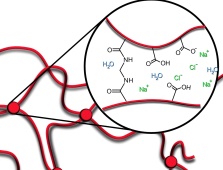
 A hydrogel is a polymer network containing charges in the main chain (see picture on the left). Due to the repulsion between the charged main chains it can swell with water to enormous size, 1 g of Hydrogel can uptake up to 1000 g of water. This functionality is used in several application fields: baby diapers, packing (food), sealant, agriculture or drill fluids in oil production to name just a few.
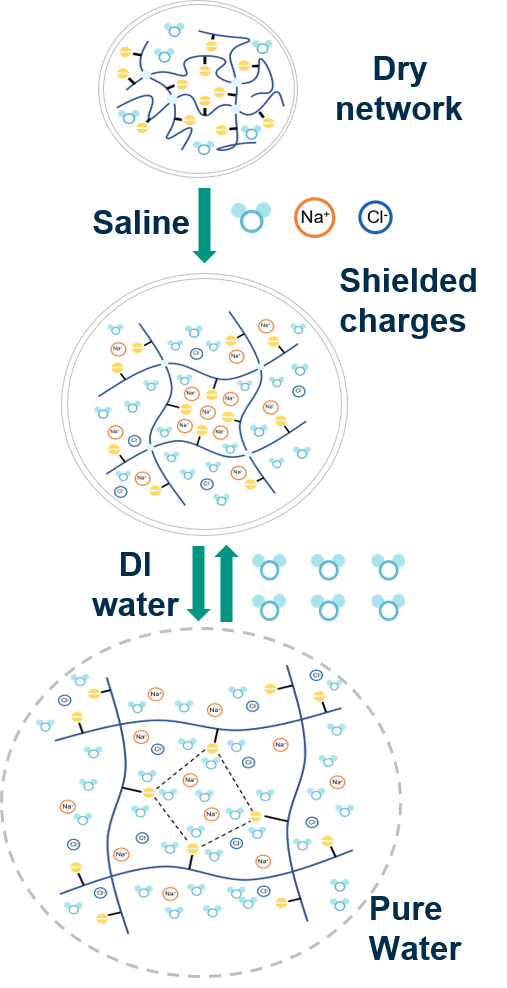
The electrostatic interaction of polymers in solution is dependent on the the ionic strength, additional salt in the medium reduces the interaction between the the polymer chains. This effect is a general property of the Coulomb interaction, the resulting potential is known as screened coulomb potential or Debye-Hückel potential. Therefore, if you add additonal charges to the water, the electrostatic repulsion of the polymer chains will decrease resulting in a less swollen hydrogel. This you can see in the picture at the right.
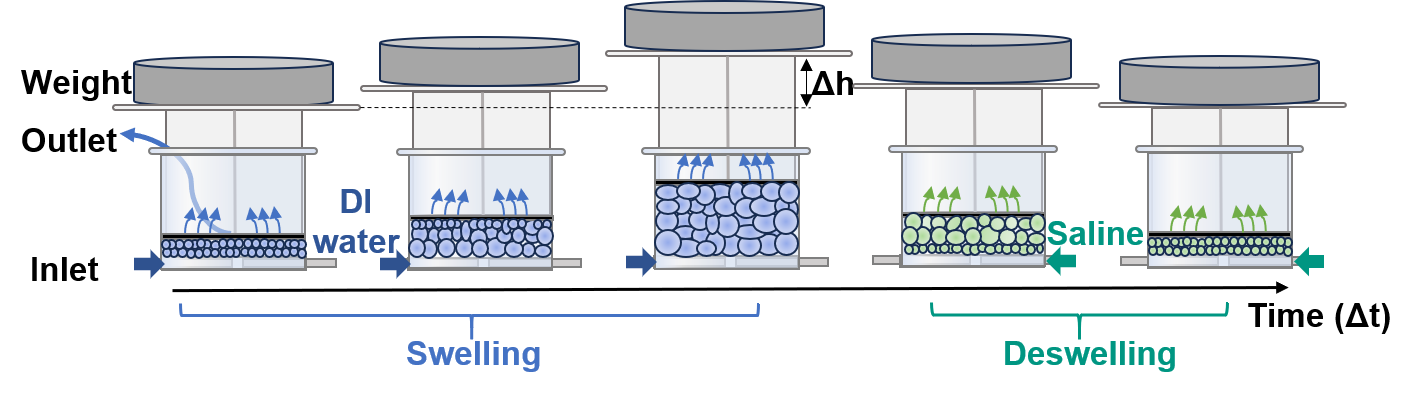
Using this feature of the coulomb interaction, a polymeric hydrogel and the concentration gradient between seawater and fresh water can be used to drive a mechanical motor. This principle is shown in the following schematic picture below: