

First Version of the osmotic engine

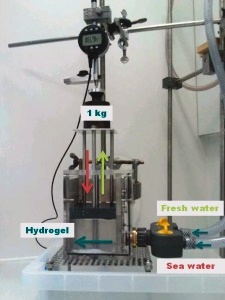 Using the ionic strength dependence of the coulomb interaction, a polymeric hydrogel and the concentration gradient between seawater and fresh water can be used to drive a mechanical motor. This we could demonstrate with our lab experiment shown in the picture at the right.
In the start, the hydrogel is swollen with salt water, therefore expands only to a small extend. If you flash the hydrogel with fresh water, it will swell to its maximum extend, this volume expansion can be used to create mechanical force, in this case to lift a weight.
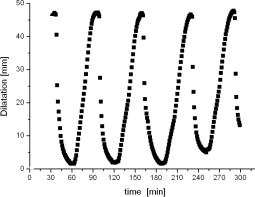 In our experiment we use 10g of a commercial hydrogel consitsing of particles in the size range of several 100 µm. As fresh water we used de-ioinzed water, as seawater a NaCl-Solution of 4.3 weight percent (Ionic strength of 0.729 mol/l). One Cycle (swell and deswell) needs 1 h of time, we were able to lift a weight of 1.5 kg (weight + apparature).
On the way to technical used machine one important property is a constant swelling capability of the gel over a high number of repetition cycles. This is shown in the diagramm on the left for 5 cycles.
In the video below the same 5 cycles are shown, 1 picture is taken every 15 sec, the resulting movie is played with 25 frames per second, e.g. with a time-lapse of 1:375.