

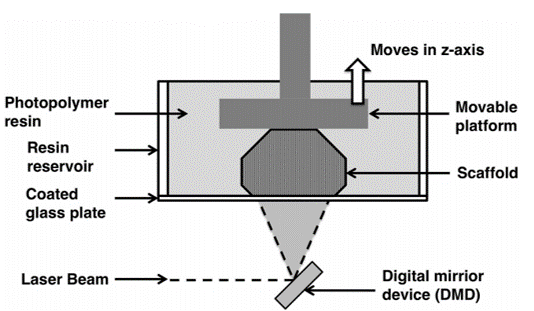
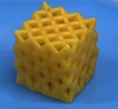
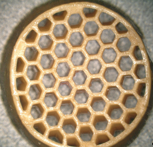
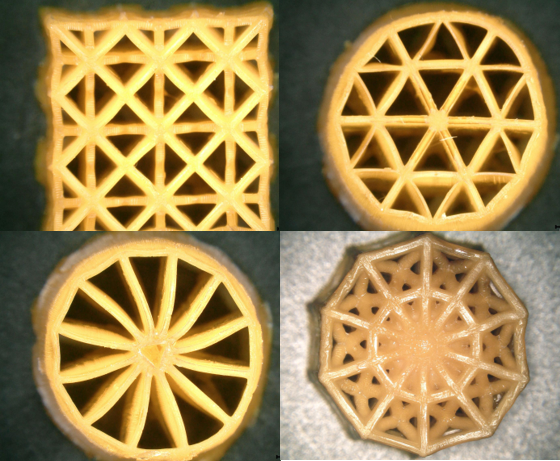
With this technique, you produces particles of typically 20 mm, in the height this is the maximum dimension. In spite of the overall size, the shape is totally flexible so one has still control about swelling times due to small material thickness, the problem ogf gelblocking can be avoide even better than with the microfluidic synthesis. Goal is the perfect Structure design to achieve instant expansion while maintain mechanical strength.
The 3D-Printing is a layered method with roughly 200µm layer thickness and 5s exposure time per layer resulting in a quite fast method for hydrogels in complicated shapes. Smaller time leads to unfinished polymerization and unprinted structures while too much time leads to rigidity and possible blockage. Size and shape of the particles can be adapted to the specific problem, possible shapes we already printed you can see below.